
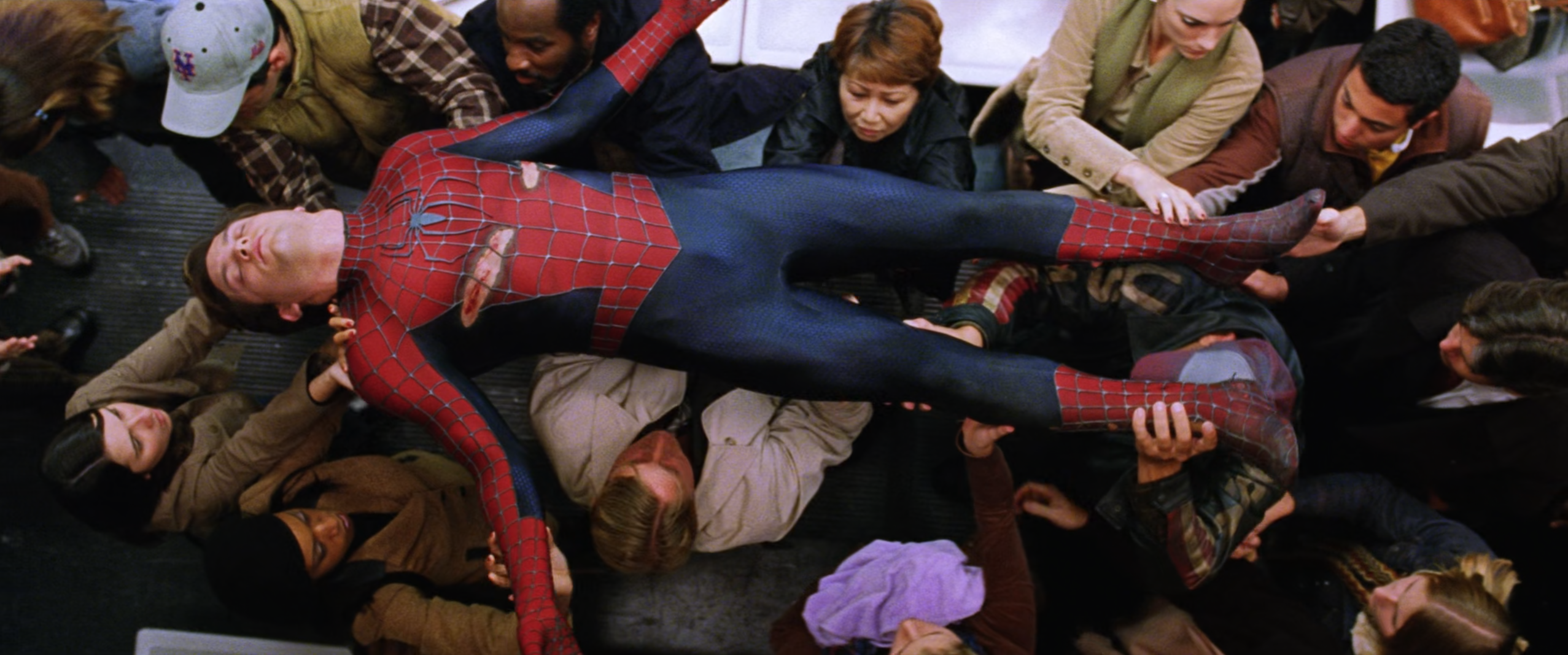
Whenever Lent rolls around, I always get in the mood to watch films about people suffering. Tales of tragic heroes that just get absolutely destroyed by life. Films like Spider-Man 2.
Peter Parker was just an ordinary boy, until he was bitten by a radioactive spider, granting him extraordinary powers. After grappling with the temptation to use his powers selfishly, he eventually took up the responsibility of fighting crime in New York City as the masked superhero – Spider-Man.
Young boys adore Spider-Man. They all think he’s the coolest, fighting bad guys and being an awesome hero. Yet the truth is, being Spider-Man kind of stinks.
Since Peter has to keep his true identity a secret, he receives no praise or thanks for the sacrifices he makes. He gets fired from his pizza delivery job for being late all the time, and he’s failing college because he keeps missing classes. Being Spider-Man also means he can’t spend time with the people he cares about. He can only watch as the girl he loves gets engaged to a man who can actually be there for her. Meanwhile, his aunt is about to lose her house after missing too many mortgage payments, and Peter is unable to do anything about it since he’s barely making ends meet himself (needless to say, being Spider-Man doesn’t pay much).
Soon, Peter finds himself losing his powers. What once felt so easy has become so very hard. He tries to tell a doctor about his problems without giving himself away, saying that he’s been having dreams about being Spider-Man, but that he keeps falling every time he tries to climb a wall. The doctor tells him, “Well, what if you’re not supposed to be Spider-Man? Maybe that’s why you keep falling.” And it sounds reasonable. Peter is tired, beaten down by life. Why should he continue to sacrifice so much if he’s getting nothing out of it?
Has there been a time in your spiritual life where you felt like you were “losing your powers“?
It feels great to discover one’s faith at first, like you’ve got this energy inside you that drives you to do good work, to give up the possessions that bind you. But then time passes, and life isn’t as great as it used to be. You are plagued by problems, even at Church, and nobody seems grateful for the work you do. God doesn’t seem to respond to you, so prayer feels pointless. You may wonder, why do I have to live a life of self-denial and sacrifice, for a God that may or may not exist, who seems so cold and distant? We forget the graces that we’ve been given and the calling to do good in the world. We start longing for the life we left behind. We feel tired and it seems so reasonable to just stop. “What if God doesn’t love you? What if They don’t even exist? Maybe that’s why you keep falling.”
To be selfish is the most powerful temptation because it’s just so reasonable. And so Peter gives in. He throws away his costume and gives up his “responsibility”.
And initially, it feels liberating.
He happily goes to class and catches up on his homework, finally finds the time to see his best friend’s play, and munches on a hot dog as he watches police cars fly past, glad that he no longer has to “get involved”. Yet something starts to feel wrong. He sees a man being robbed in an alleyway, and later on watches as a horrible apartment fire takes the lives of several unfortunate souls. He tries to make amends with the girl he loves, but it seems she’s moved on already. And his aunt loses her house anyway.
“Am I not supposed to have what I want?” Peter wonders to himself, no longer able to enjoy his newfound “freedom”. Later on, he pays his aunt a visit as she’s packing up her belongings, and she talks about Spider-Man’s sudden disappearance, and the need for more heroes in the world. “I believe there’s a hero in all of us,” she says. “Keeps us honest. Gives us strength. Makes us noble. Even if it means that sometimes, we have to be steady, and give up the things we want the most. Even our dreams.”
It’s at this point that Peter realizes his problem: he was still trying to have it all. He wanted to be both Spider-Man and Peter Parker, to maintain two separate lives at the same time. That was what was tearing him apart. He still hadn’t fully let go of who he once was.
By the end of the film, he accepts that his personal life will always be in service to his true responsibility (being Spider-Man), and his powers return. Of course, his problems don’t magically disappear. He’s still in debt, still struggling to balance his responsibilities and personal relationships, still getting beaten up by bad guys every day. But he knows who he is. And that makes things a bit easier to bear.